
Creatives, product developers, and most entrepreneurs believe that if their product is good enough, people will simply buy it. They work themselves to the bone adding features, lowering prices, or polishing the interface, only to watch their business die in the desert of indifference.
The reality is harsher: you can have the best product in the world and still lose to nothing.
You aren’t competing against your direct rival. You aren’t fighting the sharks in the “red ocean” you intentionally sought to avoid. You are competing against fear, laziness, and the “we’ve always done it this way” mentality.
These forces might not feel material, but if you don’t understand the physics of change, you aren’t marketing a product—you’re just shouting at a wall. Or a mountain whose mass you haven’t correctly calculated.
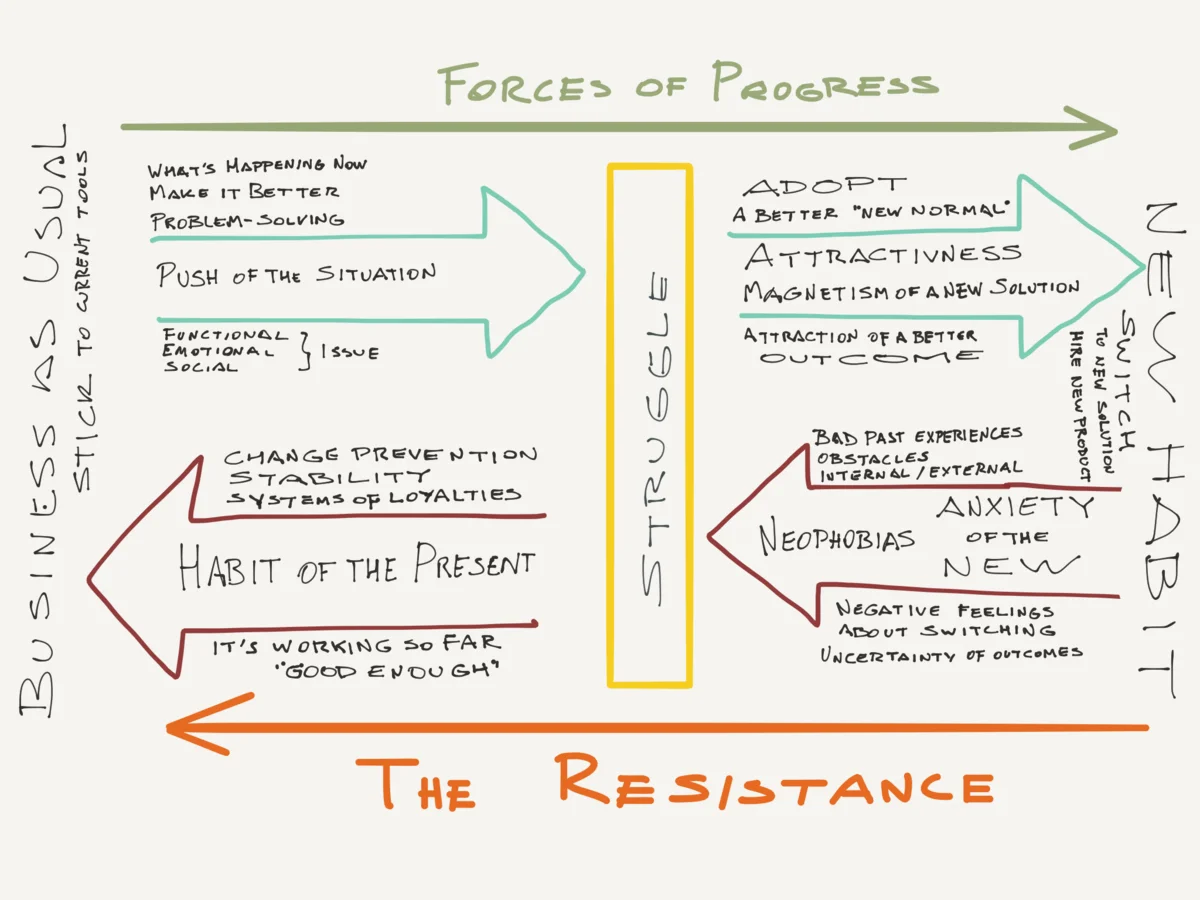
Bob Moesta and Clayton Christensen gave us a useful lens: human progress as a balance of four force vectors.
(Push + Pull) > (Anxiety + Inertia)
Calculate accordingly.
Once that clicks, you start doing napkin math on every human interaction — and you stop guessing why people don’t move. You understand where to find signals, what questions to ask, how to pull new details to expand your understanding of the dynamics at play.
For someone to “hire” your solution, the forces of movement must outweigh the forces of resistance:
The Accelerator (Driving the change)
- The Push (Repulsion): The kinetic energy of current pain.
- Example: You don’t switch your accounting firm because of a “nicer logo.” You switch because they missed a tax deadline and the government just sent you a fine. That’s a heck of a strong repulsive force.
- The Pull (Magnetism): The gravity of a better life.
- Example: It’s not about “new software.” It’s the vision of finally leaving the office at 5:00 PM because your workflow is actually automated, instead of spending your Sunday nights in a spreadsheet.
The Brake (Holding them back)
- The Anxiety (Uncertainty): The “handbrake” of the unknown.
- Example: The fear that “moving my data might corrupt the files.” Even if the new tool is better, the fear of a 1% catastrophic error keeps people paralyzed.
- The Inertia (Current Habits): The comfort of the “devil you know.”
- Example: Using a clunky CRM because “everyone already knows the keyboard shortcuts.” Habit has a gravity that rewards staying in a mediocre situation.
The Engineered Progress
Progress isn’t a matter of desire; it’s a balance of power in a given direction. They’re feeling your product like a signpost were you are calling for attention and saying: “Hey guys! Here! Let’s go this way.”
It is a fundamental mistake to focus solely on Attraction. Is good to have as much as you can it but is not their final destination. Also a “nice pull” is useless if it is completely overwhelmed by an unaddressed Anxiety or the undetected force of Current Habits. You are asking your product’s value proposition to do work it realistically cannot do.
Desire validates attraction, but the resistance of comfort neutralizes initiative.
Facilitating change must be intentional, designed, and built. That often means the logistics of removing every stone from your customer’s road before they even try to reach yours. People don’t buy a product; they buy an improved version of themselves.
You are either the optimizer of that progress, or you are invisible.
If your customer feels the pain of missing opportunities but is paralyzed by fear, your job isn’t to sell them more features. Your job is to dissolve their fear, break their routine, and prove that the danger of remaining stagnant is far greater than the risk of moving forward.
You can surrender to your current habits, but your product will keep loosing to inertia.
Stop trying to accelerate while stepping on the brake.