
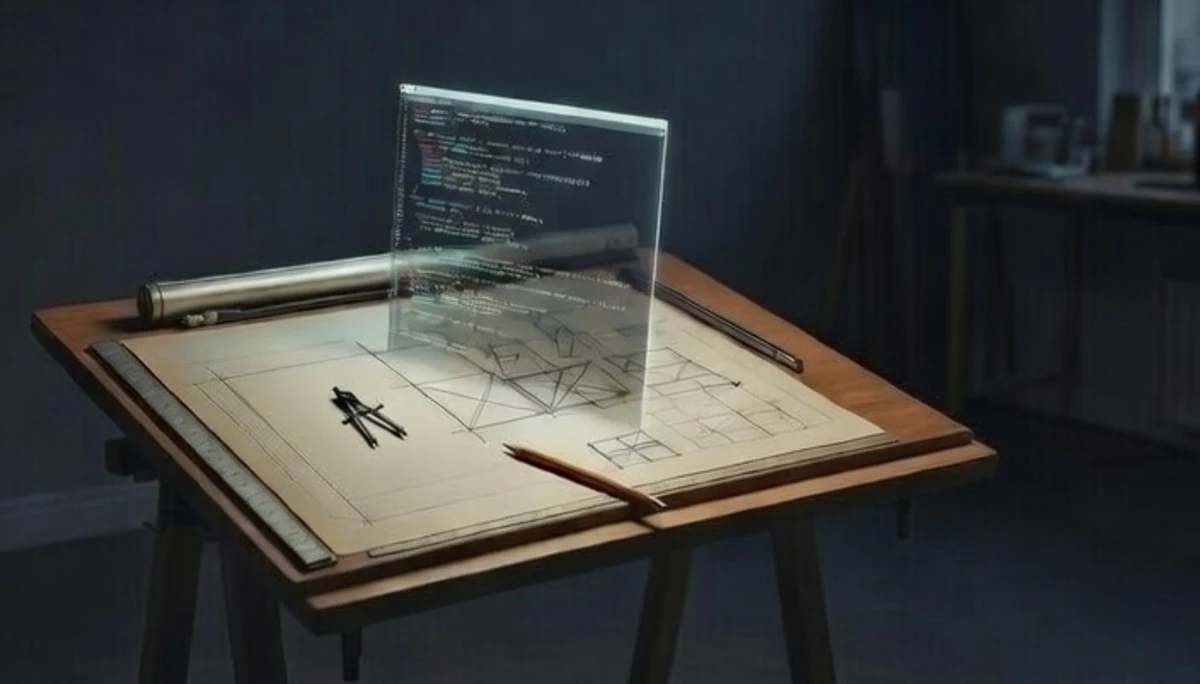
Fortran. Lisp. C. Smalltalk. Ruby. Rust.
Seventy years of increasingly powerful languages, each one turning the previous generation’s hard problems into routine. Then, somewhere around 2025, the list took a turn nobody on it anticipated.
English.
Well, natural language.
Not a syntax. Not a virtual machine. Not a paradigm. Not even a formal language. Just what you’d say to a colleague. AI transpiles your intent into source code so compilers can translate it to machine instructions. The exclusive discipline that required mastering at least one programming language? Over. The bottleneck that kept most people from building software? Dissolved.
An MVP, coded in a week. Senior-level architecture. Maybe not production-grade, but demo-ready — and from there you can go places. Any language you want. It’s not fiction anymore.
So now what?
This isn’t just happening to code.
Architecture is design for buildings. A craftsman making high-fashion shoes is a designer for footwear. A typographer designs reading experiences. A novelist designs characters and their stories.
The heavy lifting of execution is being disrupted everywhere. Not just in software. Across every discipline where “making the thing” used to be the hard part.
When the making gets cheap, what’s left?
What’s left is the filters that let you express intent when building something. Having the discernment of what to build and why.
What’s left is design.
Not design as “make it pretty.” Design as the discipline of shaping how something works, how it’s experienced, how it communicates intent before a single word is read or a single button is pressed.
But not just product shaping either. Design as the process behind the product. How the paths for its growth get their friction removed. When we think strategy, we are designing a route. Steering. Shaping a journey.
If execution is now 90% handled (or choose your number) the question isn’t “can I build it?” It’s “do I know what to build and why this shape?”
How to answer that? With an evasive maneuver — a short-term win that saves the day — or a frontal, long-term adaptive answer?
Place your bet.
Here is one: Own it.
Be the factory owner. Own the attention that used to go to execution by owning the process of how your product is shaped, how it shapes its audience’s experiences, and how it reaches them.
Fill it with what makes a remarkable product for its given people. Finding them means you found the commonalities, and detecting those patterns means you’re sensitive to good design.
Here is where most technical people quietly fail.
Lack of proportion: not helping the user navigate their journey.
Poor contrast: you fail to communicate what’s important the moment it sits next to something else.
Poor balance or missed alignments: you reveal kindergarten-level design thinking.
Unclear hierarchy: your proposals feel dumb or unintelligible.
Lack of unity: your entire promise is weak and insubstantial.
Disregarded patterns: you’re just another one who shipped something “almost good enough.”
These aren’t aesthetic preferences. They’re structural failures. The same way a buffer overflow or a race condition is in code, except they live in the layer your users actually touch.
You can prompt an AI to produce senior-level internal software architecture. You cannot prompt your way into understanding why your product feels wrong to hold.
Every product has a designer who expressed intent when shaping it. Every user experiencing that shape receives a force of progress or of friction. That symbolization process is happening whether you designed it deliberately or by neglect.
The factory is yours now. AI put the machines, the materials, and the labor in the hands of anyone willing to use them.
But a factory without someone who understands processes, proportion, contrast, balance, hierarchy, unity, and patterns isn’t a factory. It’s a warehouse full of parts nobody wants to assemble.
People notice fast when the job is incomplete.
Keep ignoring that you shape every level and you’re removing yourself from the possibility of being a builder. You’ll own the machines but not know what they should make — or for whom — or why anyone should care.
Once natural language is the new programming language, design is the new programming language.
Program well.